
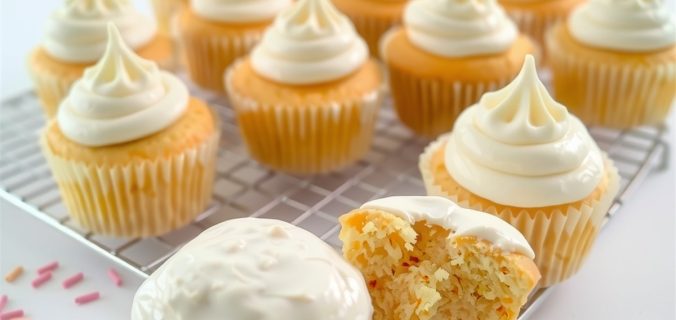
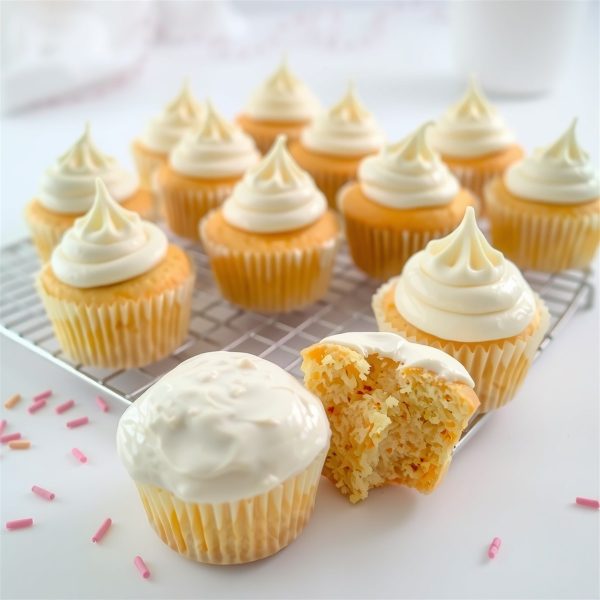
The photo above was generated using AI. Made this and have a real photo? We’d love to feature it — submit yours here.
Cupcakes are a small butter cake and they go wrong in predictable ways — domed and cracked, sunken in the middle, or peeling away from the case. All three are fixable and none of them is about the recipe.
Makes 12. About 40 minutes including the icing.
Fill the cases two-thirds, no more
The commonest mistake and the easiest to fix.
Fill a case to the brim and the batter has nowhere to go but up and over. You get a mushroom top that spills onto the tray, a cupcake that’s impossible to ice flat, and cases that peel away because the overflow has stuck to the tin.
Two-thirds full. It looks like too little. It rises to exactly level with the top of the case, which is what you want for icing, and it gives you twelve even cupcakes instead of nine large ones and three sad ones.
An ice cream scoop makes them uniform. So does a jug and a bit of care.
Room temperature butter and eggs
Butter creams properly only in a narrow temperature window — around 18–20°C, cool but yielding to a finger. Straight from the fridge it won’t hold air; melted or greasy it won’t either, and the batter splits.
Cold eggs added to creamed butter cause it to curdle, because the fat seizes on contact. A split batter bakes into a dense, slightly greasy cupcake. Take the eggs out with the butter, an hour before you start, and add them one at a time.
If it does split, a tablespoon of the flour beaten in usually brings it back.
Don’t overmix once the flour is in
Beating the butter and sugar wants three or four minutes — you’re deliberately whipping air in, and that air is a good part of the rise.
Once the flour goes in, stop as soon as it disappears. Every extra turn develops gluten, and gluten in a cake means a tough, chewy, tunnelled crumb. This is the difference between light and rubbery.
Fold the last of it by hand rather than trusting the mixer to know when to stop.
Why they dome, sink, or peel
Domed and cracked — oven too hot. The outside sets before the middle has finished rising, so the middle bursts through. Drop to 170°C.
Sunken in the middle — underbaked, too much raising agent, or the oven door was opened in the first fifteen minutes. Check with a skewer rather than the clock.
Cases peeling away — usually overfilled batter sticking to the tin, or cupcakes left to cool in the tin so steam condensed between the case and the cake. Get them onto a rack after five minutes.
Buttercream: the ratio, and the one that isn’t gritty
Two parts icing sugar to one part butter, by weight. So 250 g butter to 500 g icing sugar ices twelve cupcakes generously.
Two things make buttercream unpleasant, and both are avoidable. Sift the icing sugar — unsifted lumps never dissolve and you get grittiness. And beat it for far longer than feels necessary, five minutes at least, adding a tablespoon or two of milk. Properly beaten buttercream is pale, almost white, and noticeably lighter than the beige paste most people stop at.
A pinch of salt cuts the sweetness considerably and almost no recipe includes it.
Frequently asked questions
How full should I fill cupcake cases?
Two-thirds. It looks like too little and it’s correct — they rise to level with the top of the case, which is what you want for icing. Overfilled cases spill over and peel away.
Why did my cupcakes dome and crack?
The oven was too hot. The outside set before the middle finished rising, so the middle burst through. Bake at 170°C rather than 180°C.
Why did my cupcakes sink in the middle?
Underbaked, too much baking powder, or the oven door was opened in the first fifteen minutes. Check with a skewer rather than the stated time.
Why did the paper cases peel away?
Either overflowing batter stuck to the tin, or they cooled in the tin and steam condensed between the case and the cake. Move them to a rack after five minutes.
Why is my batter curdled?
Cold eggs added to creamed butter. The fat seizes on contact. Use room temperature eggs and add them one at a time. A tablespoon of the flour beaten in usually rescues a split batter.
What’s the ratio for buttercream?
Two parts icing sugar to one part butter, by weight — 250 g butter to 500 g icing sugar ices twelve cupcakes generously.
Why is my buttercream gritty?
The icing sugar wasn’t sifted. Lumps in icing sugar don’t dissolve in an uncooked icing. Sift it every time.
Why is my buttercream yellow and heavy?
It wasn’t beaten long enough. Five full minutes after all the sugar is in, with a splash of milk, turns it pale and light. Most people stop at two.
Can I make cupcakes ahead?
Bake them up to two days ahead and keep them airtight, unfrosted. Iced cupcakes are best on the day. Unfrosted they freeze for three months.
Can I use this batter for a cake?
Yes — a 20 cm round tin at 170°C for about 35 minutes.
Variations
- Chocolate — replace 1/4 cup of the flour with cocoa, and add 2 Tbsp cocoa to the buttercream.
- Lemon — the zest of two lemons in the batter, and lemon juice in place of the milk in the icing.
- Funfetti — 1/3 cup sprinkles folded in at the end. Non-negotiable for a child’s birthday.
- Cream cheese icing — swap the buttercream for cream cheese icing, which suits a carrot or banana version.
- Filled — cut a small cone from the top of each cooled cupcake, spoon in jam or lemon honey, and replace the lid before icing.
| Prep Time | 20 minutes |
| Cook Time | 20 minutes |
| Servings |
cupcakes
|
- 125 g butter softened to room temperature
- 3/4 cup caster sugar 165 g
- 2 eggs at room temperature
- 1 tsp vanilla extract
- 1 1/2 cups plain flour 225 g
- 2 tsp baking powder
- 1/4 tsp salt
- 1/2 cup milk 125 ml
- 250 g butter softened
- 4 cups icing sugar sifted, 500 g
- 2 Tbsp milk
- 1 tsp vanilla extract
- Pinch of salt
Ingredients
Cupcakes
Buttercream
|
|
- Take the butter and eggs out of the fridge an hour ahead. Heat the oven to 170°C (150°C fan) and line a 12-hole muffin tin with paper cases.
- Beat the butter and sugar for 3–4 minutes until pale and fluffy.
- Add the eggs **one at a time**, beating well after each. Add the vanilla.
- Sift in the flour, baking powder and salt, add the milk, and fold together **just until the flour disappears.** Don't beat it.
- Divide between the cases, filling each **two-thirds full** — no more.
- Bake for 18–20 minutes, until risen, level and golden, and a skewer comes out clean. Don't open the oven in the first 15 minutes.
- Cool in the tin for 5 minutes, then move to a rack to cool **completely** before icing.
- For the buttercream, beat the butter alone for 2 minutes, then add the sifted icing sugar in three additions, beating well. Add the milk, vanilla and salt and **beat for a further 5 minutes** until pale and light.
- Pipe or spread onto the cooled cupcakes.