
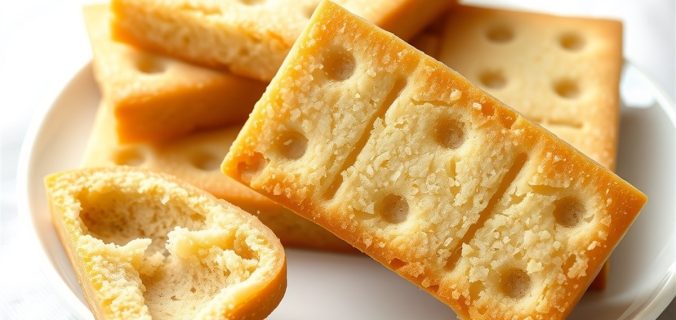
The photo above was generated using AI. Made this and have a real photo? We’d love to feature it — submit yours here.
Shortbread is four ingredients and no leavening, no eggs and no liquid, which means there’s nothing to hide behind. It’s also almost impossible to get badly wrong once you understand the two things that make it short rather than hard.
This makes 24 pieces in about 50 minutes, and it keeps for three weeks in a tin, which is why it’s a Christmas biscuit.
The 3-2-1 ratio
Three parts flour, two parts butter, one part sugar, by weight. Every good shortbread recipe is a variation on it, and if you remember the ratio you never need the recipe again — 300 g flour, 200 g butter, 100 g sugar makes a standard batch.
That’s a lot of butter relative to flour, and it’s the point. “Short” in baking means high fat, low gluten development. The fat coats the flour particles and physically stops them linking into gluten strands, which is what gives shortbread its crumble instead of chew.
Why the cornflour
Swapping a portion of the plain flour for cornflour is the single easiest improvement to make. Cornflour contains no gluten-forming protein at all, so it dilutes the flour’s capacity to toughen. The result is noticeably more tender and it melts rather than snaps.
Rice flour does the same job and adds a faint sandiness that some people prefer — it’s the traditional Scottish addition. Either works. Straight plain flour makes a harder, more biscuity shortbread.
Don’t overwork it, and don’t let it get warm
Cream the butter and sugar only until just combined — pale and fluffy is what you want for a cake, not for this. Beating air in gives you a puffed, cakey shortbread.
Then bring the flour in with as few turns as possible, and stop the moment it comes together. If the dough is warm and greasy by the time you’ve finished, chill it for twenty minutes before shaping.
Bake it low, and take it out pale
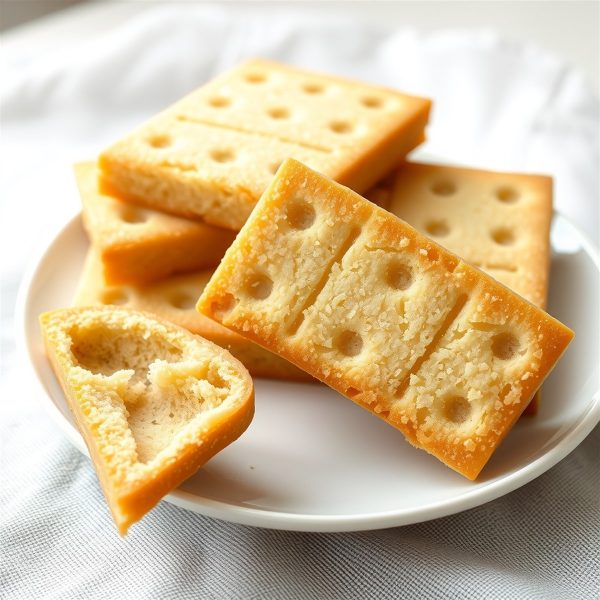
This is where most shortbread goes wrong. It should be baked at 150°C for a long time, and it should come out pale gold at the edges and barely coloured in the middle.
Shortbread that’s golden brown all over has gone too far — the butter has browned and the texture has tightened. It will still taste fine. It just won’t be short.
It also comes out of the oven soft and firms as it cools, so don’t judge it in the tin. Cut it while it’s still warm, because cold shortbread shatters under a knife.
Frequently asked questions
Why is my shortbread hard instead of crumbly?
Two usual causes. The dough was overworked, which develops gluten, or it was baked too hot and too long. Shortbread should bake low at 150°C and come out pale, not golden brown.
What is the 3-2-1 ratio for shortbread?
Three parts flour, two parts butter, one part sugar, by weight — so 300 g, 200 g, 100 g. Every classic shortbread is built on it.
Why put cornflour in shortbread?
Cornflour has no gluten-forming protein, so replacing some of the plain flour with it makes the biscuit more tender. Rice flour does the same and adds a slight sandiness, which is the traditional Scottish version.
Can I use salted butter?
Yes, and leave out the added pinch of salt. Some people prefer it — a little salt against that much butter is no bad thing.
Why prick it with a fork?
It lets steam escape so the shortbread stays flat and dense rather than puffing up in patches. Prick right through to the base of the tin.
Why cut it warm?
Shortbread is fragile when cold and will crack unpredictably under a knife. Cut it 10 minutes out of the oven while it’s still soft, then let the pieces cool in place.
How long does shortbread keep?
Three weeks in an airtight tin at room temperature, which is why it’s a Christmas biscuit. Don’t refrigerate it — it goes hard.
Can I freeze the dough?
Yes. Wrap and freeze for up to three months, then thaw in the fridge before pressing into the tin. Baked shortbread also freezes well.
Variations
- Lemon — the zest of two lemons with the sugar.
- Chocolate-dipped — dip one end of each cooled finger in melted dark chocolate.
- Rosemary and sea salt — 1 Tbsp finely chopped rosemary in the dough, flaky salt on top. Very good with cheese.
- Ginger — 2 tsp ground ginger and 1/3 cup finely chopped crystallised ginger.
- Petticoat tails — press into a round tin, score into wedges before baking, and cut along the score lines while warm.
| Prep Time | 15 minutes |
| Cook Time | 35 minutes |
| Servings |
pieces
|
- 250 g butter softened
- 1/2 cup caster sugar 110 g
- 2 cups plain flour 300 g
- 1/2 cup cornflour 75 g
- Pinch of salt
- extra caster sugar for dusting
Ingredients
|
|
- Heat the oven to 150°C (130°C fan). Line a 20 × 30 cm slice tin with baking paper.
- Beat the butter and sugar together until just combined and smooth. Don't beat air into it — you're not making a cake.
- Sift in the flour, cornflour and salt, and mix on low or by hand only until it comes together into a soft dough. Stop as soon as there's no loose flour.
- Press the dough evenly into the tin, smoothing the top with the back of a spoon. Prick all over with a fork, in rows, right through to the base.
- Bake for 30–35 minutes. It's ready when the edges are pale gold and the centre is set but barely coloured. Do not let it brown all over.
- Dust with caster sugar while hot, then cut into 24 fingers **while still warm** — it will shatter if you wait until it's cold.
- Leave in the tin to cool completely before lifting out. It firms up considerably as it cools.