
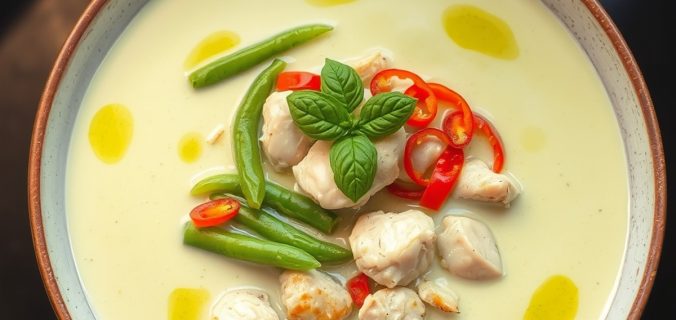
The photo above was generated using AI. Made this and have a real photo? We’d love to feature it — submit yours here.
Most homemade green curry is coconut milk with curry paste stirred through it. It’s fine. It also tastes flat and slightly one-note, and the gap between that and a good green curry comes down to two things — one technique, one balance.
Serves 4, about 30 minutes.
Crack the coconut cream first
This is the step almost every home version skips, and it’s the difference.
Take the thick cream from the top of an unshaken can of coconut milk and fry it in a hot pan on its own for three or four minutes. It will bubble, then separate — you’ll see clear oil pooling out of the white solids. That’s “cracking”, and it’s what Thai cooks do first.
Then fry the paste in that separated oil for two minutes. The paste is full of aromatics — lemongrass, galangal, kaffir lime, shrimp paste — that are fat-soluble, meaning they only release their flavour into oil, not water. Stirring paste into liquid coconut milk barely wakes it up. Frying it in cracked coconut oil transforms it.
You’ll smell the difference from across the kitchen. That’s the whole trick.
Bought paste is fine — buy a good one
Making green curry paste from scratch means sourcing fresh galangal, kaffir lime leaves, coriander root and shrimp paste, and pounding them. It’s worth doing once. It’s not worth doing on a Tuesday.
A good bought paste beats a mediocre homemade one. Look for brands where the ingredient list starts with actual aromatics rather than water and thickener — the Thai imported brands in the Asian aisle are generally much better and much cheaper than the supermarket-brand jars.
Use more than the jar says. Most jars suggest two tablespoons for four people; three or four is closer to right for a New Zealand palate expecting flavour.
The balance: salty, sweet, sour
Thai food is built on balancing those three, and a curry that tastes “not quite right” is nearly always out on one of them.
- Salty comes from fish sauce, not salt. Two tablespoons for this quantity.
- Sweet comes from palm sugar, or brown sugar at a pinch. One tablespoon. It isn’t there to make the curry sweet — it rounds the salt and the chilli.
- Sour comes from lime juice, added off the heat at the end. Cooked lime juice goes bitter and dull.
Taste at the end and adjust. Too flat, add fish sauce. Too sharp, add sugar. Too heavy, add lime.
Don’t boil it once the coconut milk is in
A hard boil splits coconut milk into grainy solids and oil. Once the rest of the can goes in, keep it at a bare simmer.
What to do about the hard-to-find things
Fresh galangal and kaffir lime leaves are in Asian grocers in the main centres and nowhere else in New Zealand. If you can’t get them:
- Galangal — no good substitute. Ginger is not the same thing but is better than nothing. A decent bought paste already contains galangal, which is another argument for using one.
- Kaffir lime leaves — the frozen ones from an Asian grocer are excellent and keep for a year. Otherwise a strip of lime zest gets you part of the way.
- Thai basil — regular basil is a reasonable stand-in; it’s sweeter and less aniseedy.
Frequently asked questions
Why does my green curry taste flat?
The paste wasn’t fried. Curry paste aromatics are fat-soluble, so stirring the paste into coconut milk barely releases them. Crack the coconut cream first and fry the paste in the separated oil for two minutes.
What does “cracking” coconut cream mean?
Frying the thick cream from the top of the can until it separates into white solids and clear oil, usually 3–4 minutes. That oil is what you fry the paste in.
Should I make my own curry paste?
A good bought paste beats a mediocre homemade one, and the imported Thai brands in the Asian aisle are usually far better than supermarket-brand jars. Make your own once for interest, not on a weeknight.
How much curry paste should I use?
More than the jar suggests. Three to four tablespoons for four people, against the two most jars recommend.
Why did my coconut milk go grainy?
It boiled. Once the thin coconut milk is in, keep the curry at a bare simmer — a hard boil splits it into solids and oil.
When do I add the lime juice?
Off the heat, at the very end. Cooked lime juice turns bitter and loses its brightness.
What can I use instead of galangal or kaffir lime leaves?
There’s no real substitute for galangal — ginger is different but better than nothing. Frozen kaffir lime leaves from an Asian grocer keep for a year and are worth buying. A good bought paste contains both already.
Can I make it vegetarian?
Yes — tofu or chickpeas instead of chicken, and soy sauce or a vegetarian fish sauce substitute. Check the paste, as most contain shrimp paste.
Can I freeze it?
Yes, three months, though the coconut milk can separate slightly on thawing. Reheat gently and stir.
Variations
- Prawn — raw prawns added in the last 3 minutes.
- Beef — thinly sliced rump, added at the end and cooked for 2 minutes only.
- Vegetarian — tofu, chickpeas or roasted kūmara; check the paste for shrimp.
- Red curry — the same method with red curry paste, which is milder and sweeter than most people expect.
- Extra vegetables — Thai eggplant, bamboo shoots, or baby corn are all traditional.
| Prep Time | 15 minutes |
| Cook Time | 15 minutes |
| Servings |
servings
|
- 2 × 400 ml cans coconut milk **not shaken**
- 3-4 Tbsp Thai green curry paste
- 600 g chicken thigh fillets sliced
- 1 Tbsp fish sauce plus more to taste
- 1 Tbsp palm sugar or brown sugar
- 4 kaffir lime leaves torn, optional
- 1 courgette sliced
- 150 g green beans trimmed
- 1 red capsicum sliced
- 1 cup Thai basil or regular basil leaves
- juice of 1 lime
- 1 red chilli sliced, to serve
- steamed jasmine rice to serve
Ingredients
|
|
- Open the cans without shaking them and spoon the thick cream from the top of one into a wok or large pan. Reserve the rest.
- Fry the coconut cream over a medium-high heat for 3–4 minutes, until it bubbles, thickens and visibly separates, with clear oil pooling out. **Don't rush this** — it's the step that makes the curry.
- Add the curry paste and fry in the separated oil for 2 minutes, stirring, until it darkens and smells strongly aromatic.
- Add the chicken and stir to coat, cooking for 3 minutes until it turns opaque on the outside.
- Pour in the remaining coconut milk, add the fish sauce, sugar and lime leaves, and bring to a **bare simmer**. Don't let it boil.
- Simmer gently for 8 minutes, then add the beans and courgette and cook 3 minutes, then the capsicum for a final 2. The vegetables should keep some bite.
- Take off the heat. Stir through the basil and the lime juice.
- Taste and adjust: fish sauce for salt, sugar for balance, lime for lift. Serve over jasmine rice with sliced chilli.