
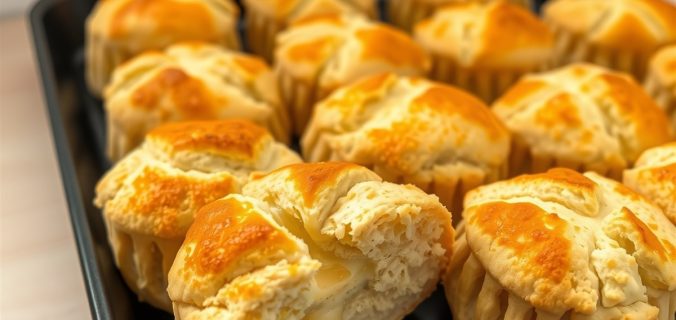
The photo above was generated using AI. Made this and have a real photo? We’d love to feature it — submit yours here.
Search for a cheese scone recipe and you’ll get a lot of small, polite, English ones. A New Zealand cheese scone is a different object — bigger, taller, considerably cheesier, and eaten split and buttered while it’s still too hot to hold comfortably. Morning tea, cafe cabinet, school gala, funeral. It has a job to do.
This makes 12 large scones in about 30 minutes, and the two things that decide whether they rise tall or come out flat are both about restraint.
Cold butter, and barely touch it
Scones rise because cold butter melts in the oven and leaves steam pockets behind. Warm butter blends into the flour and you get a dense, cakey scone instead.
So: butter straight from the fridge, rubbed in only until the mixture looks like rough breadcrumbs with visible flecks of butter still in it. Not fine, not sandy. Flecks.
Then, once the milk goes in, mix as little as you can get away with. A shaggy, slightly untidy dough is a good sign. Every extra turn develops gluten and gluten makes scones tough. If your scones come out heavy, this is nearly always why.
Don’t twist the cutter
Push the cutter straight down and lift it straight out. Twisting seals the cut edge and the scone rises lopsided or not at all. If you don’t have a cutter, cut the dough into squares with a knife — no rounding, no re-rolling, and the scraps problem disappears.
Cheese in it and cheese on it
Two cups of grated tasty cheese goes into the dough, and another half cup goes on top before baking. The topping is not decoration. It melts down over the sides and crisps against the tray, which gives you the browned, slightly chewy cheese crust that separates a good cheese scone from a plain scone with cheese in it.
Use tasty or a sharp cheddar. Mild cheese vanishes. Colby is what a lot of people have in the fridge and it will do, but it’s noticeably blander.
The mustard and cayenne
A half teaspoon of mustard powder and a pinch of cayenne won’t make the scones taste of mustard or of chilli. They sharpen the cheese — the same reason both turn up in a cauliflower cheese or a Welsh rarebit. Leave them out and the scones taste flatter, and you won’t be able to say why.
Frequently asked questions
Why are my cheese scones flat and heavy?
Almost always overmixing, or butter that wasn’t cold enough. Mix only until the dough just comes together — it should look rough and shaggy, not smooth. Also check your baking powder is fresh; it loses strength after about six months open.
Why did they rise lopsided?
You twisted the cutter. Push straight down and lift straight up.
What cheese is best for cheese scones?
A tasty or sharp cheddar. It needs enough flavour to survive 15 minutes at 220°C. Mild cheese and colby both work but taste noticeably plainer.
Can I make cheese scones without baking powder?
Use self-raising flour and leave the baking powder out, though you’ll get a slightly lower rise. Three cups of self-raising flour replaces the flour and baking powder here.
Can I use buttermilk?
Yes, and they’ll be marginally lighter and slightly tangy. Use the same quantity and add 1/2 teaspoon of baking soda along with the baking powder.
Can I freeze them?
Yes, baked and cooled, for up to three months. Refresh from frozen in a 180°C oven for 8 minutes — far better than microwaving, which makes them rubbery.
Why put cheese on top as well as inside?
The cheese on top melts down the sides and crisps against the tray. That browned cheese crust is most of what people mean when they say a cheese scone is good.
Variations
- Cheese and bacon — add 3 rashers, cooked and chopped, with the cheese.
- Cheese and chive — 3 tablespoons of finely snipped chives.
- Cheese and jalapeño — 2 tablespoons of finely chopped pickled jalapeños, drained well.
- Cheese and Marmite — spread a thin layer of Marmite on each scone before the cheese topping goes on. Divisive, and very good.
| Prep Time | 15 minutes |
| Cook Time | 15 minutes |
| Servings |
scones
|
- 3 cups plain flour 450 g
- 4 tsp baking powder
- 1 tsp salt
- 1/2 tsp mustard powder
- pinch of cayenne pepper
- 75 g cold butter cubed
- 2 cups Tasty Cheese grated, 200 g
- 1 1/2 cups milk plus a little extra for brushing, 375 ml
- 1/2 cup Tasty Cheese extra, for the tops, 50 g
Ingredients
|
|
- Heat the oven to 220°C (200°C fan). Line a baking tray with baking paper.
- Sift the flour, baking powder, salt, mustard powder and cayenne into a large bowl.
- Add the cold cubed butter and rub it in with your fingertips until the mixture looks like rough breadcrumbs. Stop while you can still see small flecks of butter — don't work it smooth.
- Stir through the 2 cups of grated cheese.
- Make a well in the centre, pour in the milk, and mix with a butter knife just until it comes together into a shaggy dough. It should look untidy. Do not knead it.
- Tip onto a lightly floured bench and pat out to about 3 cm thick — thicker than feels right. Cut into 12 rounds or squares, pushing the cutter straight down without twisting.
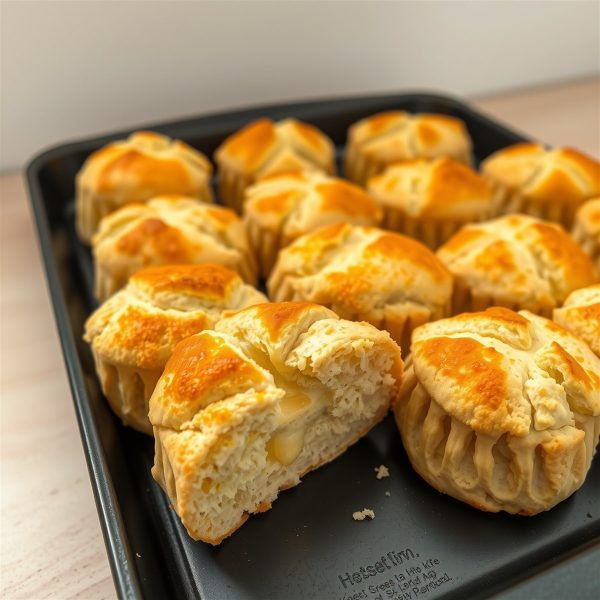
- Sit them on the tray close together, almost touching, so they support each other as they rise. Brush the tops with a little milk and scatter over the extra cheese.
- Bake for 12–15 minutes, until well risen and deep golden with browned cheese on top.
- Eat warm, split and buttered. They are at their best within an hour of coming out of the oven.