
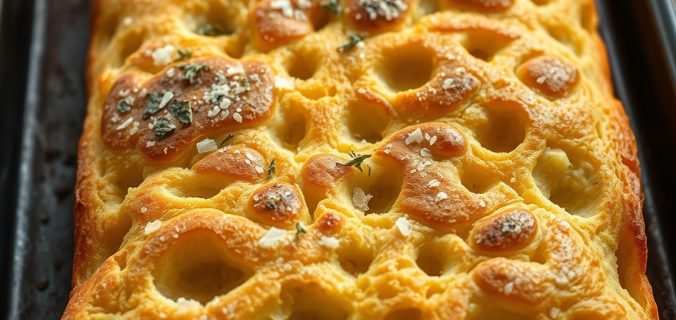
The photo above was generated using AI. Made this and have a real photo? We’d love to feature it — submit yours here.
Focaccia looks like it should be difficult and it is the opposite — no kneading, one bowl, and a dough so wet you couldn’t knead it if you wanted to. What it needs is time, and almost all of that is unattended.
Serves 8 generously. About 24 hours from start to finish, of which maybe fifteen minutes is work.
The dough is supposed to be too wet to handle
This is the thing people get wrong, because it doesn’t behave like bread dough should.
Focaccia runs at around 80% hydration — 800 g of water to a kilo of flour. That is a batter more than a dough. It will pour rather than sit, it will stick to everything, and your instinct will be to add flour until it feels like bread. Don’t.
The water is what makes the bubbles. As the loaf bakes, all that water turns to steam and blows the crumb open into the big irregular holes that define good focaccia. A drier dough gives you a tidy, even, close crumb — pleasant, and not focaccia.
Use a bowl and a spatula, and oiled hands when you need to touch it.
No kneading, just folds
High-hydration dough develops gluten on its own if you leave it alone — the flour hydrates fully and the gluten strands organise themselves without any help. That’s what “no knead” actually means.
All you do is four sets of folds in the first two hours: reach into the bowl with a wet hand, pull one side of the dough up and over the middle, turn the bowl a quarter, repeat four times. Thirty seconds, then leave it half an hour. Do that four times.
Each set of folds builds structure and traps gas. After the fourth you’ll notice the dough has gone from a sloppy puddle to something that holds a shape.
The overnight cold rise
Same argument as the pizza dough, and even more worthwhile here. Twelve to twenty-four hours in the fridge gives you flavour a two-hour rise cannot produce, and it also firms the dough enough to handle.
Straight from the fridge into the oiled tin, then a final two-hour rise at room temperature before it bakes.
Be much more generous with the oil than feels right
A quarter cup in the tin under the dough, and another quarter cup poured over the top. That is not a typo, and it is not a mistake.
The oil in the bottom of the tin fries the base as it bakes, which is where the crisp golden underside comes from. Oil on top pools in the dimples and does the same to the surface. Focaccia baked with a modest amount of oil is just flat bread.
Use a decent olive oil. At this quantity you can taste it.
Dimple hard, right to the bottom
Oil your fingers and push straight down through the dough until you feel the tin. Not gentle presses — proper holes, all over.
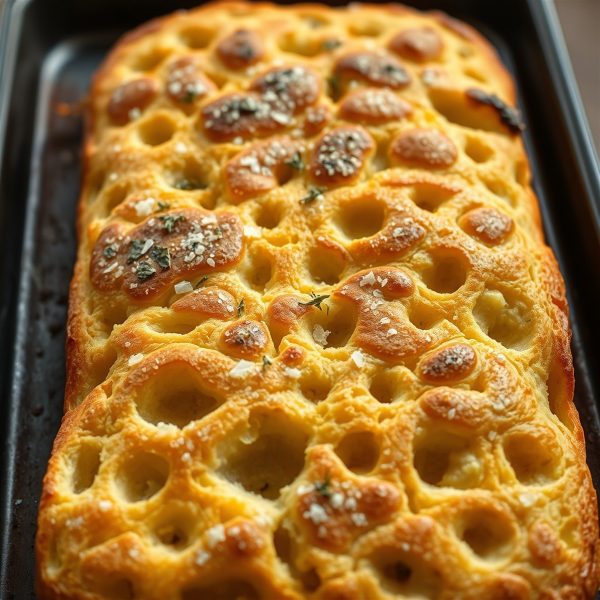
The dimples do two things. They stop the loaf doming into a bread shape, and they create wells for oil and salt to collect, which is where most of the flavour ends up. Timid dimpling gives you a puffy loaf with a smooth top.
Right before it goes in, scatter flaky salt over. A splash of water mixed with the top oil helps it distribute.
Frequently asked questions
Why is my focaccia dough so wet?
Because it should be. Focaccia runs at about 80% hydration and the water is what creates the big open bubbles. It will feel wrong. Don’t add flour — use a spatula and oiled hands.
Do I need to knead focaccia?
No. Four sets of folds over the first two hours does the same job. High-hydration dough develops gluten on its own given time.
Why doesn’t my focaccia have big holes?
The dough was too dry, or it was knocked back too hard when it went into the tin. Handle it gently after the fridge — you want to keep the gas that’s already in it.
How much olive oil should I use?
More than feels sensible. A quarter cup in the tin and a quarter cup on top. The oil underneath fries the base crisp; the oil on top pools in the dimples. It’s the defining feature of the bread.
Can I make focaccia in one day?
Yes — skip the fridge and let it rise at room temperature for 2 hours after the folds, then 1 hour in the tin. It’s good. The overnight version is better.
Why is my focaccia dense?
Under-proved, or the dough was too dry. It should be visibly puffy and spread to the edges of the tin before it goes in the oven. Cold kitchens need longer than the recipe says.
How do I dimple it properly?
Oil your fingers and push straight down until you feel the tin. Firmly. Timid dimples disappear as it bakes and you end up with a domed loaf.
How long does focaccia keep?
Best on the day. Two days in a paper bag at room temperature, and it revives well in a hot oven for 5 minutes. It freezes for two months.
Variations
- Rosemary and salt — the classic, and included above.
- Tomato and olive — halved cherry tomatoes and kalamata olives pressed into the dimples before baking.
- Potato — very thinly sliced potato overlapping across the top with rosemary. A Ligurian classic.
- Caramelised onion — a slow-cooked onion spread over before baking.
- Garlic and herb oil — infuse the top oil with crushed garlic and thyme first, warmed gently and cooled.
| Prep Time | 20 minutes |
| Cook Time | 25 minutes |
| Servings |
servings
|
- 4 cups high grade flour 600 g
- 2 cups warm water 480 ml
- 2 tsp instant dried yeast
- 2 tsp fine salt
- 1/2 cup olive oil divided, 125 ml
- 2 tsp flaky sea salt
- 2 sprigs rosemary optional
Ingredients
|
|
- Combine the flour, yeast and fine salt in a large bowl. Add the water and 2 Tbsp of the olive oil, and mix with a spatula until there's no dry flour left. It will be a wet, sticky, unpromising mass. Cover.
- Over the next 2 hours, do four sets of folds, half an hour apart: wet one hand, reach under one side of the dough, pull it up and fold it over the middle, then turn the bowl a quarter turn and repeat four times. Cover again between sets.
- Cover well and refrigerate for 12–24 hours.
- Pour 1/4 cup of the olive oil into a 20 × 30 cm tin and spread it over the base and sides. Tip the cold dough in and gently coax it toward the corners — it won't reach yet, and that's fine.
- Cover and leave at room temperature for 2 hours, until doubled, puffy and spread to the edges.
- Heat the oven to 220°C (200°C fan).
- Pour the remaining oil over the top. Oil your fingers and **dimple the dough firmly all over, pushing right down to the base of the tin.** Scatter over the flaky salt and press in rosemary sprigs if using.
- Bake for 22–25 minutes, until deep golden on top and the base is crisp when you lift a corner.
- Lift out of the tin onto a rack straight away — left in the tin it steams and the base softens. Eat warm.