
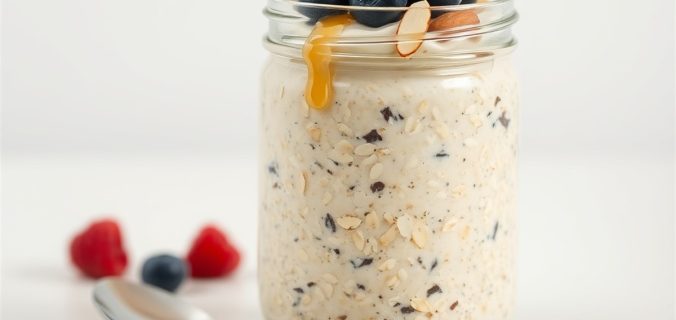
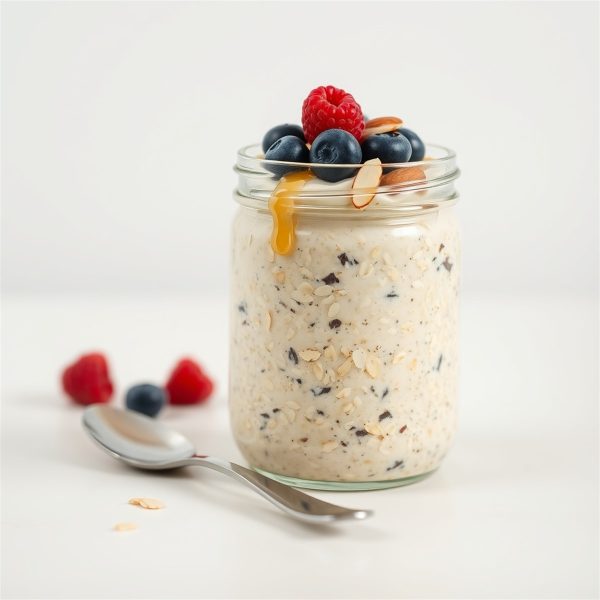
The photo above was generated using AI. Made this and have a real photo? We’d love to feature it — submit yours here.
Overnight oats are five minutes of work the night before and nothing at all in the morning, which is the entire appeal. They’re also easy to get wrong in a way that puts people off for good — too much liquid and you get soup, too little and you get cement.
The ratio is the recipe. Everything else is preference.
Serves 1. Scale it up in the same jar proportions.
The ratio: 1:1, then adjust
Equal volumes of rolled oats and liquid. Half a cup of each per person, which sets to a thick, spoonable, porridge-like consistency overnight.
That’s the starting point, and it’s the one most recipes get wrong by adding too much milk. If you like it looser, go to 1:1.25. If you want it very thick — closer to a set pudding — stay at 1:1 and add a tablespoon of chia seeds, which absorb several times their own volume.
Yoghurt counts as liquid but behaves differently. A half-and-half split of milk and yoghurt gives a thicker, tangier result and is worth doing. Straight yoghurt makes them very dense.
Rolled oats, not instant and not steel-cut
This matters more than the ratio.
Rolled oats (also sold as wholegrain or old-fashioned oats) are steamed and flattened. They absorb liquid steadily overnight and hold their shape, so you get distinct oats in a thick base.
Instant or quick oats are cut finer and pre-cooked further. They absorb liquid almost immediately and break down completely, which is why overnight oats made with them come out as a uniform grey paste. This is the single commonest reason people say they don’t like overnight oats.
Steel-cut oats barely absorb anything cold. They’ll still be hard in the morning.
Four hours minimum, two days maximum
Four hours is enough for rolled oats to fully hydrate — so you can make them in the morning for lunch, not just overnight.
They keep two days in the fridge, three at a push. Beyond that the oats keep swelling and the texture goes claggy, and any fresh fruit in there starts to go.
Make a jar for tomorrow and a jar for the day after. Don’t make five.
Add-ins: what goes in now, what goes on later
In at the start: chia seeds (they need time to gel), cinnamon, cocoa, protein powder, peanut butter, honey or maple syrup, mashed banana, grated apple.
On at the last minute: fresh berries, sliced banana, nuts, seeds, granola, coconut. Nuts and granola go soft overnight and lose the entire point of adding them. Fresh berries bleed and go mushy.
Frozen berries are the exception — stirred in at the start they thaw overnight and release their juice through the oats, which is genuinely good.
A pinch of salt
Two grams of salt in a jar of oats does not make them salty. It makes them taste of something. Overnight oats without salt taste flat and slightly cardboardy no matter how much honey you add, and almost no recipe mentions it.
Frequently asked questions
What is the ratio for overnight oats?
Equal volumes of rolled oats and liquid — half a cup of each per person. That sets thick and spoonable. Add more liquid for a looser result, or a tablespoon of chia seeds for a thicker one.
Can I use instant oats?
You can, but they turn to paste. Instant oats are cut fine and pre-cooked, so they absorb liquid immediately and break down completely. Rolled oats are what you want.
Can I use steel-cut oats?
Not for this. Steel-cut oats barely absorb liquid cold and will still be hard in the morning.
How long do overnight oats need?
Four hours minimum, which means you can make them in the morning for lunch. Overnight is convenient rather than necessary.
How long do they keep?
Two days in the fridge, three at a push. Beyond that the oats keep swelling and go claggy.
Why are my overnight oats gluey?
Either instant oats were used, or they’ve been sitting more than three days. Both cause the oats to break down completely.
When do I add the fruit and nuts?
Fresh fruit, nuts and granola go on in the morning — they go soft or mushy overnight. Frozen berries are the exception and are good stirred in at the start.
Can I make them without yoghurt?
Yes, use all milk. Yoghurt makes them thicker and tangier but it isn’t essential. Any plant milk works too.
Can I eat them warm?
Yes, microwave for a minute and stir. It’s essentially porridge at that point, and perfectly good, though it defeats the convenience.
Do I really need the salt?
Yes. A pinch makes the difference between oats that taste of something and oats that taste of nothing. Almost no recipe mentions it and it’s the easiest improvement to make.
Variations
- Apple and cinnamon — half a grated apple and 1 tsp cinnamon in at the start.
- Chocolate peanut butter — 1 Tbsp cocoa and 1 Tbsp peanut butter in at the start, banana on top.
- Berry — 1/2 cup frozen mixed berries stirred in at the start; they thaw and bleed through overnight.
- Feijoa — 1/2 cup scooped feijoa flesh in at the start. Very good, and very seasonal.
- Bircher — grated apple, sultanas, lemon juice and a little cream stirred through in the morning, which is the original Swiss version.
| Prep Time | 5 minutes |
| Cook Time | 0 minutes |
| Servings |
servings
|
- 1/2 cup rolled oats 45 g
- 1/4 cup milk 60 ml
- 1/4 cup natural yoghurt 60 g
- 1 Tbsp chia seeds
- 1 tsp honey or maple syrup
- 1/2 tsp vanilla extract
- Pinch of salt
- fresh fruit nuts, seeds or granola
Ingredients
To serve
|
|
- Put the oats, chia seeds and salt into a jar or container with a lid and stir to combine.
- Add the milk, yoghurt, honey and vanilla. Stir thoroughly, making sure there's no dry oat left at the bottom — that's where lumps come from.
- Seal and refrigerate for at least 4 hours, or overnight.
- In the morning, stir once. If it's thicker than you like, loosen it with a splash of milk.
- **Now** add the fresh fruit, nuts, seeds or granola on top, and eat cold.