
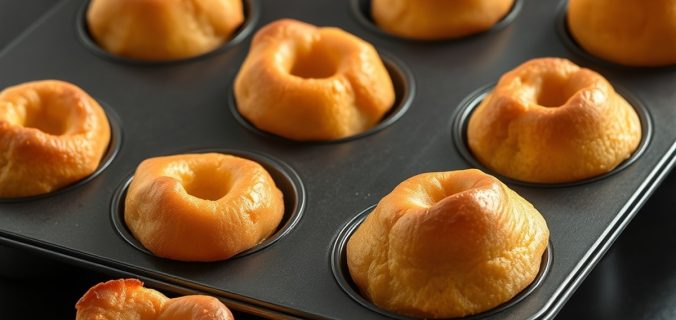
The photo above was generated using AI. Made this and have a real photo? We’d love to feature it — submit yours here.
Yorkshire puddings are flour, eggs, milk and salt. There is nothing in the ingredient list that can go wrong, which means every failure is a technique failure — and there are only three techniques that matter.
Makes 12. About 40 minutes, plus resting time for the batter.
Equal volumes of egg, flour and milk
Forget weights. Measure the eggs in a jug, then use the same volume of flour and the same volume of milk.
Four eggs come to roughly 200 ml, so that’s 200 ml of flour and 200 ml of milk. It scales perfectly and it works with any size of egg, which weight-based recipes don’t.
This is the classic ratio and it produces a thin batter — about the consistency of pouring cream. If your batter is thick like a pancake batter, it’s wrong, and the puddings will be dense.
Rest the batter — at least 30 minutes, an hour is better
Two things happen while the batter rests.
The flour fully hydrates, so the starch granules swell and the batter thickens slightly and becomes smoother. And the gluten you developed by whisking relaxes, which lets the pudding expand freely instead of fighting itself.
Thirty minutes minimum at room temperature. An hour is better. Overnight in the fridge is better still, though take it out 30 minutes before using — cold batter into hot fat gives a smaller rise.
A rested batter can rise noticeably higher than one used immediately, for zero extra effort.
The fat must be smoking hot
This is the one that matters most, and it’s where most failures happen.
Put the fat in the tin, put the tin in a 220°C oven, and leave it for 10 full minutes until the fat is visibly shimmering and beginning to smoke. Then pour the batter in — it should hiss and spit immediately.
That instant heat flash-sets the outside of the pudding and turns the water in the batter to steam, and it’s the steam that inflates it. Batter poured into merely warm fat sits there, cooks slowly from the outside, and produces a flat dense disc.
Beef dripping is traditional and best. Lard, goose fat or the fat from your roast all work. Vegetable oil works fine and is what most people use — just not olive oil or butter, both of which burn below the temperature you need.
About a teaspoon of fat per hole, and don’t fill the holes more than halfway with batter.
Do not open the oven
Not to check, not to turn the tray, not for twenty minutes.
Opening the door drops the oven temperature sharply and the puddings, which are held up entirely by steam pressure, collapse. They will not come back.
Look through the glass. If your oven door has no window, wait the full time.
Why they sink afterwards
Some deflation as they cool is normal — the steam holding them up condenses. Serve them within a couple of minutes of coming out and it doesn’t matter.
If they collapse dramatically the moment they leave the oven, they were undercooked. They should be deep golden brown and feel dry and crisp, not pale and soft. Give them the full 20 minutes and don’t be nervous about the colour.
Frequently asked questions
Why didn’t my Yorkshire puddings rise?
Almost always the fat wasn’t hot enough. It needs 10 minutes in a 220°C oven until it’s shimmering and beginning to smoke, and the batter should hiss when it goes in. The other common causes are opening the oven door, and batter that was too thick.
What is the ratio for Yorkshire pudding batter?
Equal volumes of egg, flour and milk. Measure the eggs in a jug first, then match that volume with flour and with milk. It scales to any number of eggs.
Do I have to rest the batter?
It makes a real difference. Thirty minutes minimum, an hour is better, overnight is best. The flour hydrates and the gluten relaxes, both of which let the pudding rise higher.
Can I open the oven to check?
No. The puddings are held up by steam pressure and opening the door drops the temperature enough to collapse them permanently. Look through the glass.
What fat should I use?
Beef dripping is traditional and gives the best flavour. Lard, goose fat or the fat from your roast all work. Vegetable oil is fine. Don’t use butter or olive oil — both burn below the required temperature.
Why did they sink after I took them out?
Some deflation as they cool is normal. Dramatic collapse means undercooked — they should be deep golden and feel dry and crisp, which takes the full 20 minutes.
Can I make the batter ahead?
Yes, up to a day in the fridge. Take it out 30 minutes before using; cold batter rises less.
Can I freeze Yorkshire puddings?
Yes, and they reheat surprisingly well. Cool completely, freeze, then reheat from frozen at 220°C for 5 minutes. Better than most frozen shop-bought ones.
Can I make one big one?
Yes — that’s a traditional Yorkshire pudding, baked in a single roasting dish and cut into squares. Use the same batter, the same hot fat, and bake for 30–35 minutes.
Variations
- Toad in the hole — brown sausages in the tin first, pour the batter around them, and bake for 35 minutes in a single dish.
- One large pudding — a single roasting dish, cut into squares, which is the older way of serving it.
- Herb — 1 Tbsp finely chopped thyme or rosemary in the batter.
- Mustard — 1 tsp mustard powder in the flour, which suits beef particularly well.
- Mini puddings — a 24-hole mini muffin tin and 12 minutes, for canapés filled with rare beef and horseradish.
| Prep Time | 10 minutes |
| Cook Time | 22 minutes |
| Servings |
puddings
|
- 4 eggs about 200 ml
- 200 ml plain flour about 120 g
- 200 ml milk
- 1/2 tsp salt
- freshly ground black pepper
- 4 Tbsp beef dripping lard or neutral oil
Ingredients
|
|
- Crack the eggs into a measuring jug and note the volume. Measure the same volume of flour and the same volume of milk.
- Whisk the eggs, flour, milk, salt and pepper together until completely smooth and about the consistency of pouring cream. Pour it back into the jug.
- **Rest for at least 30 minutes** at room temperature, or overnight in the fridge.
- Heat the oven to 220°C (200°C fan). Put a teaspoon of dripping or oil into each hole of a 12-hole muffin tin and put the tin in the oven for **10 minutes**, until the fat is shimmering and just beginning to smoke.
- Pull the tin out and, working quickly, pour the batter into each hole to **no more than halfway**. It should hiss as it hits the fat.
- Return to the oven immediately and bake for **20–22 minutes**. **Do not open the oven door.**
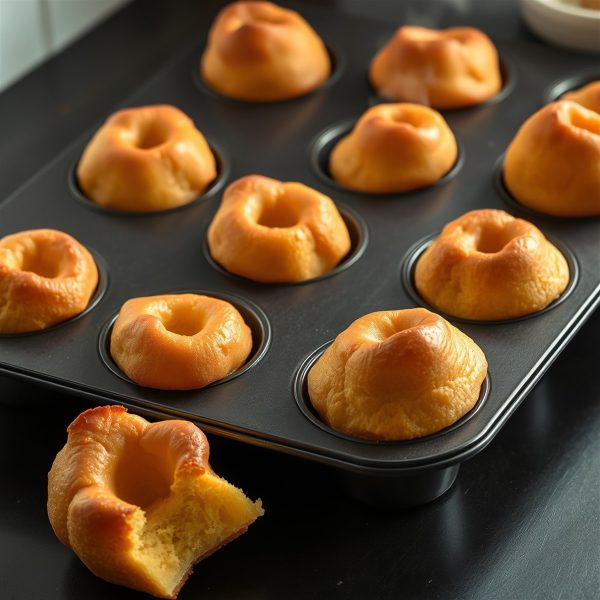
- They're ready when they're tall, deep golden brown, and dry and crisp to the touch. Serve within a couple of minutes.
Prep time: plus 30 minutes resting