

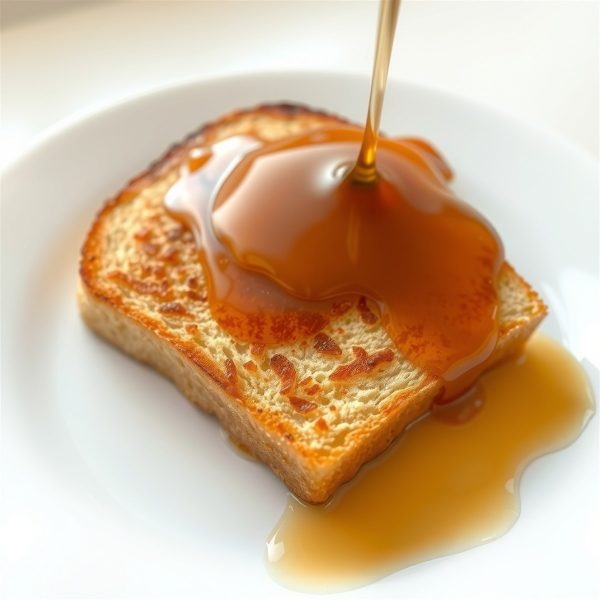
The photo above was generated using AI. Made this and have a real photo? We’d love to feature it — submit yours here.
French toast fails in two directions and most people only ever encounter one of them: soggy in the middle, or dry and eggy like a fried omelette on bread. Both come down to the same two decisions — what bread, and how hot the pan.
Serves 4, about 20 minutes.
The bread matters more than the custard
Fresh soft sandwich bread is the wrong choice, and it’s what most people reach for. It has no structure, so it collapses in the custard and turns to mush in the pan.
You want thick slices — 2 to 3 cm — of bread that’s a day or two old. Stale bread is drier, so it absorbs the custard properly instead of falling apart in it, and it holds its shape while it cooks.
Brioche is the best of it if you’re buying for the job — enriched, sturdy, and it goes gloriously custardy in the middle. A good white sourdough or a Vienna loaf both work well. Sliced supermarket sandwich bread will do at a pinch if it’s a day old and you soak it briefly, but it’s the weakest option.
The soak: long enough, not too long
The custard has to get into the middle of the slice, not just wet the outside. But leave it too long and the bread disintegrates.
About 30 seconds a side for thick brioche, 15 for thinner bread. Press it down gently so the custard reaches the centre, then lift it and let the excess drip off before it goes in the pan. Dripping custard hits the pan and scrambles into unappealing bits of cooked egg around the edges.
Squeeze the slice lightly between your fingers — it should feel heavy and saturated but still hold together.
Low and slow, not hot and fast
This is the fix for the soggy middle, and it’s counterintuitive.
A hot pan browns the outside in ninety seconds while the custard inside is still liquid. You get colour and a raw centre. Medium-low heat, 3 to 4 minutes a side, gives the egg time to set all the way through while the outside browns gently.
If your french toast is browning fast and still wet inside, the pan is too hot. Turn it down and be patient.
Butter, not oil — the browned butter is a good part of the flavour. Add fresh butter for each batch, since it burns over several rounds.
Get the custard ratio right
Too much egg and it tastes like a savoury omelette. Too much milk and it never sets.
One egg to a quarter cup of milk is the working ratio, with a spoonful of sugar and vanilla. Cream in place of some of the milk makes it richer and is worth doing if you have it.
A pinch of salt matters more than you’d think — without it the sweetness sits flat.
Frequently asked questions
Why is my french toast soggy in the middle?
The pan was too hot. It browned the outside before the custard inside had time to set. Cook it over medium-low heat for 3–4 minutes a side.
What bread is best for french toast?
Thick slices of day-old brioche. Sourdough and Vienna both work well. Fresh soft sandwich bread is the worst option — it collapses in the custard.
How long should you soak the bread?
About 30 seconds a side for thick brioche, 15 for thinner slices. It should feel saturated but still hold together. Let the excess drip off before it hits the pan.
Why does my french toast taste eggy?
Too much egg relative to milk. Stick to one egg per quarter cup of milk, and don’t skip the sugar, vanilla and salt — they’re what stop it reading as savoury.
Can I use stale bread?
You should. Day-old bread absorbs the custard properly instead of falling apart in it. If your bread is fresh, dry the slices in a 150°C oven for 5 minutes first.
Can I make french toast ahead?
It’s best straight from the pan, but it holds for 20 minutes on a rack in a 100°C oven. You can also make the custard the night before.
Butter or oil?
Butter. The browned butter is a large part of the flavour. Add fresh butter for each batch so it doesn’t burn.
Can I make it dairy free?
Yes — any plant milk works in the custard, and oil or a dairy-free spread in the pan. Coconut milk is particularly good with the cinnamon.
Variations
- Savoury — leave out the sugar, vanilla and cinnamon, add salt and pepper, and serve with bacon and a fried egg.
- Baked french toast — assemble soaked slices in a dish the night before and bake at 180°C for 35 minutes. Better for a crowd.
- Stuffed — sandwich two slices with cream cheese and jam before soaking.
- Orange and cardamom — the zest of an orange and 1/2 tsp ground cardamom in the custard.
- Coconut — coconut milk in the custard, and press the soaked slices into desiccated coconut before frying.
| Prep Time | 10 minutes |
| Cook Time | 10 minutes |
| Servings |
servings
|
- 8 thick slices day-old brioche or white bread 2-3 cm thick
- 4 eggs
- 1 cup milk or 3/4 cup milk and 1/4 cup cream, 250 ml
- 2 Tbsp caster sugar
- 1 tsp vanilla extract
- 1/2 tsp ground cinnamon
- Pinch of salt
- 50 g butter for frying
- maple syrup to serve
Ingredients
|
|
- Whisk the eggs, milk, sugar, vanilla, cinnamon and salt together in a wide shallow dish until completely smooth — no streaks of white left.
- Heat a large frying pan over a **medium-low** heat and add a knob of the butter.
- Lay two slices of bread in the custard and leave for about 30 seconds, pressing gently, then turn and do the same on the other side. Lift out and let the excess drip off.
- Cook for 3–4 minutes on the first side, until deep golden. Resist turning the heat up.
- Flip and cook another 3–4 minutes, until the second side is golden and the middle feels set rather than squashy when pressed.
- Keep warm on a wire rack in a 100°C oven while you cook the rest, adding fresh butter for each batch.
- Serve with maple syrup, and berries or crisp bacon if you like.