
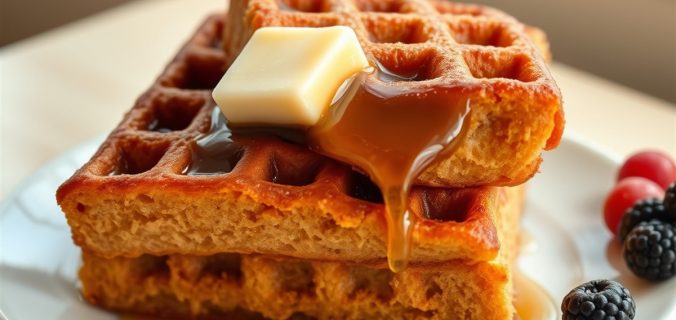
The photo above was generated using AI. Made this and have a real photo? We’d love to feature it — submit yours here.
Most homemade waffles are pancakes with a pattern on them. They come out of the iron looking right and they’ve gone soft and floppy by the time the second batch is done.
Crisp waffles are a different batter and one piece of technique, and neither is difficult.
Makes 8, about 25 minutes.
Waffle batter is not pancake batter
The two get treated as interchangeable and they shouldn’t be. A waffle needs to crisp on the outside while staying soft in the middle, and pancake batter has neither the fat nor the sugar to do it.
More fat. Butter is what crisps the surface — it fries the outside of the waffle against the hot iron. This recipe uses 125 g for eight waffles, roughly double what you’d put in the same volume of pancake batter.
More sugar. Sugar caramelises against the plates and contributes directly to the crust and the colour. It doesn’t make the waffle sweet in any noticeable way at these quantities.
A little cornflour. Replacing a quarter of the flour with cornflour lowers the gluten and gives a crisper, more brittle shell. It’s the same principle as the shortbread — less protein, less toughness.
Whisk the whites separately
Beat the egg whites to soft peaks and fold them in at the end. This is the step that separates a good waffle from a heavy one, and it takes three minutes.
The air you fold in expands in the iron and gives you the open, light interior. Without it the waffle is dense all the way through, and dense waffles never really crisp because there’s too much moisture trapped inside.
Don’t stack them on a plate
This is the technique bit, and it’s why your waffles go soggy.
A waffle straight out of the iron is full of steam. Put it on a plate and the steam has nowhere to go but back into the waffle, and the crust you just made softens within a minute. Stack two and it happens twice as fast.
Put them on a wire rack in a 100°C oven as they come off. The steam escapes, the surface stays crisp, and they hold for twenty minutes while you cook the rest. It costs nothing and it’s the difference between crisp waffles and disappointing ones.
Don’t open the iron early
The waffle sets as it cooks and the two halves knit together in the middle. Lift the lid before that’s happened and it tears in half, with the top stuck to the top plate.
Wait until the steam coming out of the sides has slowed to almost nothing. That’s the reliable signal — about 4–5 minutes on most domestic irons, regardless of what the indicator light says.
Frequently asked questions
Why are my waffles soggy?
They were stacked on a plate. A hot waffle is full of steam, and on a plate that steam soaks straight back into the crust. Put them on a wire rack in a low oven instead and they stay crisp for twenty minutes.
Can I use pancake batter to make waffles?
You can, but they won’t be as good. Waffle batter needs more butter and more sugar to crisp against the iron, and pancake batter has neither — the result is soft and pale.
Why do my waffles stick to the iron?
Either the iron wasn’t hot enough, it wasn’t greased, or the waffle was opened too early. Wait until the steam from the sides has almost stopped before lifting the lid.
Do I have to separate the eggs?
It makes a real difference to how light they are. If you’re short of time, whisk the eggs in whole — you’ll get a denser waffle that’s still perfectly good.
Can I make the batter ahead?
The base batter keeps overnight in the fridge, but fold the whisked whites in immediately before cooking. Folded in early, the air is gone by morning.
Can I freeze waffles?
Yes, and they reheat better than almost any other breakfast. Cool completely, freeze flat, then reheat straight from frozen in a toaster. Better than most shop-bought frozen waffles.
What’s the difference between Belgian and regular waffles?
Belgian waffles use a deeper iron with larger pockets and often a yeasted batter, giving a thicker, lighter waffle. This recipe suits either iron.
How much batter per waffle?
Enough to cover about three-quarters of the plate. It spreads as it cooks and as the lid comes down, and overfilling makes it squeeze out the sides.
Variations
- Buttermilk — replace the milk with buttermilk and add 1/2 tsp baking soda. Tangier and lighter.
- Savoury — leave out the sugar and vanilla, and add 1/2 cup grated cheese and 2 Tbsp chives. Very good under a poached egg.
- Chocolate — replace 2 Tbsp of the flour with cocoa and add 1/2 cup chocolate chips.
- Cinnamon — 1 tsp cinnamon with the dry ingredients.
- Yeasted overnight — a proper Belgian approach: use 1 tsp dried yeast instead of the baking powder and rest the batter overnight in the fridge.
| Prep Time | 10 minutes |
| Cook Time | 15 minutes |
| Servings |
waffles
|
- 1 1/2 cups plain flour 225 g
- 1/2 cup cornflour 75 g
- 2 Tbsp caster sugar
- 4 tsp baking powder
- 1/2 tsp salt
- 3 eggs separated
- 1 3/4 cups milk 435 ml
- 125 g butter melted and slightly cooled
- 1 tsp vanilla extract
Ingredients
|
|
- Heat the waffle iron. Heat the oven to 100°C and put a wire rack on a tray inside it.
- Sift the flour, cornflour, sugar, baking powder and salt into a large bowl.
- In a jug, whisk the egg yolks with the milk, melted butter and vanilla.
- Pour the wet into the dry and whisk just until combined. A few small lumps are fine — overmixing makes tough waffles.
- Whisk the egg whites in a clean bowl to soft peaks, then fold them through the batter in two additions. Keep it light; don't beat the air back out.
- Grease the iron lightly and pour in enough batter to cover about three-quarters of the surface — it spreads as it cooks.
- Close the lid and cook for 4–5 minutes, until the steam escaping from the sides has almost stopped. Don't open it before then or the waffle will tear.
- Move each waffle straight onto the rack in the warm oven — **not onto a plate** — and repeat with the rest.
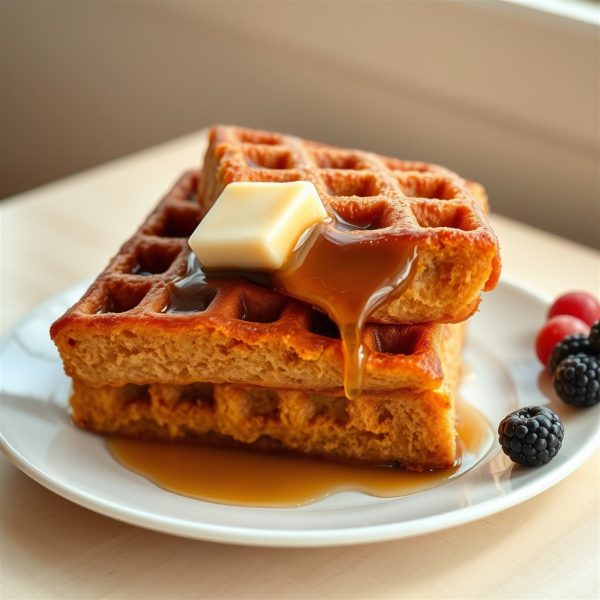
- Serve with whatever you like. Butter and maple syrup, berries and cream, or bacon.